Showing posts with label migration. Show all posts

Wednesday, 5 February 2014

SURPRISING TALES OF TRAVELLING BIRDS


Pintail (Anas acuta). Female 2º year. Carrying a pale blue nasal band [12]. It was marked in the Gargáligas reservoir (Badajoz) on 11th December 2012 and was seen in northern France on its first spring migration (2nd March 2013) and at Galisteo (Cáceres) eon its second autumn journey (25th September 2013, photo). Most of the Pintail that winter in Spain originate from northern Russia.

During 2013 SEO/BirdLife brought its vast databank from ringing up to date (more than seven million birds ringed and about 400,000 recoveries). With this information now updated, members of the public can now access it through a new app www.anillamientoseo.org through which one can consult the information, which is updated every day. Furthermore, it allows one to enter recoveries as well as requesting data on ringing and recoveries for scientific study.

In 2013 SEO/BirdLife took over the tracking management from ICONA, which had been responsible for the scientific ringing of wild birds, following a pause of two years, because of lack of funding from the Ministry of the Environment. During 2013 59,500 data were handled, that is to say 59,500 tales of travelling birds. Amongst them, we would like to highlight two related to Extremadura. Sadly, in both cases, the information came from birds killed by hunters.
The first, a Pintail (Anas acuta) was ringed by the University of Extremadura in Badajoz province in 2009 and recovered in June 2013 in Archangel (in the north of European Russia) a distance of 4,243 km. It represented the longest distance recovery from Extremadura in 2013 and the second longest from Spain.

The second, a Song Thrush (Turdus philomelos) was ringed as a nestling in Estonia (in Toolse, Laane-Virumaa) on 20th June 2013 and recovered on 17th November the same year in Olivenza (Badajoz) after 3,307 kms from its place of origin and 168 days afterwards. This was the second longest journey recorded in 2013.

Monday, 2 September 2013

BOOTED EAGLES: VALIENTE AND LUNA


Booted Eagle (Aquila pennata). Valiente, male (photo: Domingo Rivera).

In 2011 the MIGRA project of SEO/BirdLife started, dedicated to the study of the migration of birds from Spain and using, amongst other methods, satellite transmitters to track the movements of many individual birds. One of the first species involved was Booted Eagle (Aquila pennata), with 15 tagged individuals up to 2013 from various parts of Spain, including four from Extremadura, as part of a project led by the Government of Extremadura. In 2011 six birds were tracked and in 2013 it was eleven, now only ten because of the first tagged birds, a male called Valiente, was found dead, hit by a vehicle, a few weeks ago. The peculiarities of the first journey taken by Luna and Valiente, the first Booted Eagles from Extremadura that were tagged in 2011, were described before in this blog ( autumn journey and winter and spring return) and so we will not repeat the details.

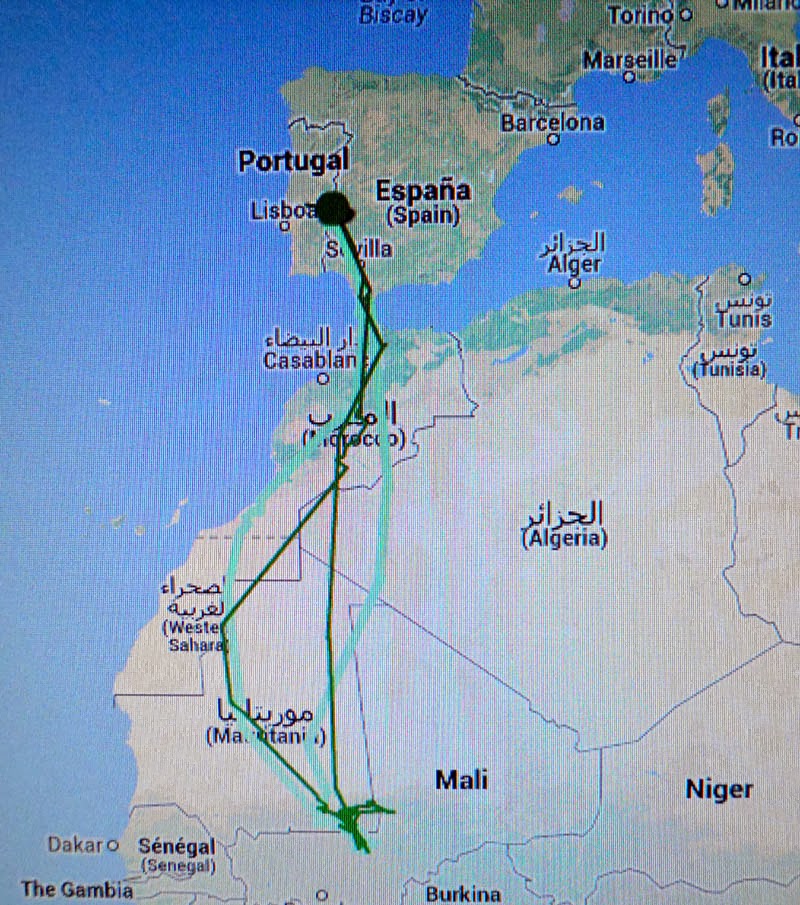
Valiente was an adult male dark morph Booted Eagle tagged at La Roca de la Sierra, Badajoz on 3rd August 2011 and whose transmitter continued to show his location until 4th August 2013, two years and a day later, when he was killed on a road between orchards in Valdelacalzada, Badajoz. A cyclist discovered the corpse and was surprised to find it was ringed and carried a yellow apparatus on its back, which he removed and returned. Domingo Rivera and Ángel Sánchez told us of his breeding history over the last three years. In 2011 Valiente successfully raised on his own a chick, as his mate had died on a wire when the chick was only a week old. In 2012, he took over a Raven’s nest in a eucalyptus tree, paired with a pale phase female and despite building a further two nests failed to breed. In 2013, he failed to pair and travelled in an erratic fashion over the area where he normally bred. With respect to his migrations, the map above shows the journeys in 2011/12 and 2012/13, very similar to each other. In both cases, he wintered in the same general area: once in Niger and the other time in Nigeria. The two-way journeys across the Sahara showed that the return journey was always to the west of the route taken in the outward journey. As can be seen in the graph below, the dates did not vary much, the 2012 journey was a bit earlier than 2011 and he spent more time in 2012 on his wintering grounds in Niger. The return journeys were almost identical in terms of dates and duration. Compared with other tagged Booted Eagles, Valiente had been unusual, being the only one with two wintering zones, one that had wintered further away (3,500 km) and the fastest in its return journeys. Of the four tagged birds from Extremadura, he was the only one that wintered in the eastern Sahel, the others staying much further to the west, between Mali and Mauritania.


Luna is an adult female dark morph, tagged in Alburquerque (Badajoz) on 3rd August 2011 and whose transmitter continues in operation. Domingo Rivera and Ángel Sánchez again describe her breeding history over the last three years. In 2011, she raised two chicks in a nest in a eucalyptus tree. In 2012, she occupied the same nest, but following its collapse because of weather conditions, she did not raise any young. In 2013, she moved to a new nest in a cork oak where again she raised two chicks. With respect to migration, the map shows the journeys made in 2011/12 and 2012/13. In both cases, she wintered in the same zone between Mali and Mauritania, some 2,500 km from the nest site, and, as with Valiente, the outward journey was more eastern than the return. In the graph below, the most interesting is that the departure date was much earlier in 2012 (5th August, a month earlier than usual). This was not seen with the other 15 tagged birds and in principle could have been explained by the breeding failure that year. However, that may not have been the reason, because in 2013, Luna also departed very early (2nd August) despite having a successful season. The return in 2013 was also earlier than in 2012, but by only a week.


The other two Booted Eagles from Extremadura that have been followed are a pair and they breed in the municipality of Badajoz, their names are Guadiana (male) and Alqueva (female). Both are pale morphs and in general their migratory behaviour has been similar to that of Luna, apart from the departure dates, with similar routes and wintering areas in the western Sahel (Mali and Mauritania).

Saturday, 27 July 2013

PICOTO, THE TRAVELLING HONEY BUZZARD

On a day just like today, exactly a year ago (26th July 2012), I had the chance to participate in the capture and marking with a satellite tracker, for the first time ever in Spain, a European Honey Buzzard (Pernis apivorus). The place: cool Pyrenean Oak woodland at 1,000 metres above sea-level on the slopes of the Jerte Valley in Cáceres province. The star: a male Honey Buzzard, we named Picoto. Here we can summarise a year in the life of an Iberian Honey Buzzard, thanks to the espionage that it was under. Photo above, by Domingo Rivera.


During the fist month, until 30th August when his southward migration started, Picoto successfully raised the single chick that was in the nest. Below, there is a photo taken on 9th August of his offspring, the not so small Picotín, who successfully left the territory several weeks later, in early September. 


The map shows the outward and return journey of Picoto, to his wintering grounds in Liberia. The southward journey took 17 days, from 3oth August to 15th September 2012. With a total of 4.085 km in a straight line, this means on average 255 km a day, with a maximum of 329 km. He stopped in La Janda (Cádiz) a day, crossing the Straits of Gibraltar on 1st September. On that very day, the largest number of Honey Buzzards of the season passed over Tarifa (Cádiz), more than 10,000 birds. Therefore Picoto was more than accompanied! Then he passed across Morocco, Algeria, Mauritania, Mali and Guinea, in a pretty much direct route across the Sahara desert.

The stay in Liberia was full of uncertainties, signals were barely being picked-up, with long gaps and always coming from a very restricted area. Suspicions rose that Picoto may have died and that the transmitter had become someone’s toy. But then, at last, after seven months of doubts, Picoto headed north again on 15th April 2013. The weak signals from October to April was probably because of the dense forest habitat where our Honey Buzzard was staying, with the canopy impeding the correct connection to the satellites. In the picture below, although some imagination may be needed, one can see the wintering area in the middle of the equatorial forests of Africa. 


Picoto’s return to his “home” in Extremadura was almost the same as his outward journey. It took just one day less (16 days) from 25th April to 10th May 2013. The journey was 200 km more (a total of 4,274 km in a straight line), with an average of 267 km a day, with the maximum considerable higher at 512 km in one day. The maximum altitude was 3,360 metres above sea-level and the maximum velocity was 41 kmph. The countries crossed were the same in reverse order: Guinea, Mali, Mauritania, Algeria and Morocco. On 8th May he crossed the straits and on 10th May was already occupying his nest from the pervious year in the Jerte valley. From then on, for reasons of security, the data from the transmitter are not available to the public, but Picoto has remained faithful to his nest site and is breeding normally, as you can see from the photo taken on 21st June, where he appears to be peacefully incubating. One can just about make out the antenna of the transmitter, with some down on its tip, coming from the back. 


Acknowledgements: Of course to long-suffering Picoto, involuntary collaborator, we hope for the benefit of all his species. A special thanks to Ivan Solana, the agent who found the nest and has been carefully monitoring Picoto and to Domingo Rivera and Ángel Sánchez, who are following the satellite data and who kindly have provided information about the adventures of our dear Honey Buzzard. In the capture and marking Javier de la Puente, José María Abad, Javier Caldera, Ángel Sánchez, Iván Solana and Domingo Rivera participated, along with a helper (Javier Prieta, who did very little apart from giving Picoto his name) and apologies a other collaborators whose names I do not know.

Translated by Martin Kelsey. 

Wednesday, 30 May 2012

BOOTED EAGLES: THE HOMECOMING

A few weeks ago we spoke in this blog entry about the African odyssey of two satellite-tagged Extremadura Booted Eagles (Hieraaetus pennatus) from September 2011 to February 2012. Like the other tagged birds in other Spanish provinces our two Booted Eagles have now come home safe and sound and seem to have got down to the task of breeding. Their return journeys were as follows.

Luna (a female, No.5 on the map) left her stable wintering area in Mali on 16 March. After passing through Mauritania, Western Sahara and Morocco she crossed the Strait of Gibraltar on 1 April, thereafter returning more slowly to her breeding territory in Alburquerque (Badajoz), where she arrived on the 6th. In total a 2700 km journey in 21 days at an average of 130 km per day and the longest stages of 344 km and 323 km on 18 and 20 March, smack in the middle of the desert. Progress within Spain was much slower, with a maximum daily stint of 120 km. In 2012 she has built a new nest only 250 m from the one used in 2011, which fell down last winter (Ángel Sánchez, pers. com.). 

Valiente (male, No.6 on the map) kicked off his trip from Nigeria on 19 March, then passing through Niger, Mali, Algeria and Morocco, crossing the Strait on 2 April and arriving back in La Roca de la Sierra (Badajoz) on 7 April. A long journey of 3500 km in 20 days, at a mean speed of 175 km per day and the longest stages of 420 and 418 km on 21 and 24 March. The longest day journey made in Spain was only 95 km. This was the swiftest moving of the six birds and one of the two with the most distant wintering area.

If we look at the whole set of six tagged birds (two in Badajoz and Madrid and one each in Castellón and Ávila) we find that the spring homecoming journey did not follow the same route as the autumn outgoing one, which was further west in all cases. The start day varied from 1 to 20 March (mean date of 13 March), the Strait crossing from 30 March to 11 April (mean date of 4 April) and the arrival on the breeding territory from 4 to 26 April (mean date of 10 April). The total distance covered ranged from 2725 to 3530 km (mean of 3095 km), the duration from 17 to 51 days (28 mean) and the average daily speed from 70 to 175 km (mean 126). Barring one bird that made the trip in two stages, stopping for a time in one of its two wintering areas, the rest came back directly, moving more rapidly through Africa and slowing down upon entering the Iberian Peninsula.

More information on the SEO/BirdLife project website "La migración de las aves" (Bird Migration).

Monday, 2 April 2012

COLOUR-RINGED SPOONBILLS SEEN IN EXTREMADURA. ANALYSIS

Spoonbill (Platalea leucorodia). Juvenile born in Holland and seen in Esparragalejo, Badajoz from 30.09.10 to 02.10.10. Five days earlier it had been seen in Irún, Gipuzkoa (photo: Ángel Sánchez).

The Spoonbill (Platalea leucorodia) has been well studied in Extremadura. Witness this blog itself, with regular reports on the monitoring of wintering and breeding birds. A particular feature of this species is the high proportion of colour-ringed birds seen in the field. It is also easy to obtain the complete back-stories of these tagged birds. The local birdwatching group SEO-Cáceres has therefore been systematically recording reports of ringed birds in Extremadura since 2008. Quite a lot of information has been built up by now, so the time seems due to take stock.

The culled information corresponds to 200 sightings of 102 different birds, the bulk dating from 2008 to 2011, together with a few from earlier years, the oldest from 2000. A special mention in dispatches must go to Sergio Mayordomo, responsible for 115 readings, and to a lesser extent Javier Prieta, with 51. A total of 21 collaborators have contributed in all (see final list).

The commonest case is a one-off sighting of a juvenile Spoonbill on autumn passage. Some birds, however, have been seen several times, with a maximum of 25 sightings of a French bird and 18 of a Dutch bird nesting in Cáceres. The Extremadura sightings were made in 23 different wetlands, with the following share-out: Alagón catchment area(102 records), Tiétar catchment area (68), south Cáceres (22) and Badajoz province(8). The sites with most sightings are Laguna de Galisteo (75) and Charco Salado, Casatejada (64). This reflects a clear bias towards the sites most visited by the most active members of SEO-Cáceres, since the Spoonbill's main locality in Extremadura, Los Canchales Reservoir, weighs in with only three records.

Origin of the ringed Spoonbills. Ringed birds seen in Extremadura come from five different countries. Two thirds of them were born in Holland; some way behind come birds from France, Spain (Andalucía) and Germany; with one Danish bird. The observed birds were born in 23 different colonies, 17 in northwest Europe (11 Holland, 3 France, 3 Germany and 1 Denmark), four in Spain and one in the Mediterranean (Camargue, France). The colonies accounting for most birds are Schiermonnikoog (Holland, 34 birds), Lago Grand Lieu (France, 12), Terschelling (Holland, 7) and Onderdijk (Holland, 7). The Andalusian birds were ringed in the saltmarshes of Odiel, Doñana (Pajarera and Casa Neves) and Cádiz Bay.


Age of the ringed Spoonbills. This is expressed in calendar years: i.e., the year of birth is the first calendar year, then clocking up an additional year each 1 January. Thus a bird born in 2008 would be in its fifth calendar year by 2012. For birds seen in more than one year their age counts again for each new sighting. In 93 cases the birds were only seen in one season, seven birds in two and two in three. The age-group accounting for most sightings was juveniles in their year of birth; 2nd and 3rd year sightings drop in number (most remain in the African wintering areas) with a slight upturn for 4th-year sightings (returning as adults), records tailing off thereafter. This tallies with this bird's mortality stats, 55% dying in their first year, 75% up to the age of 4 and 1.5% for adults (Luengo, 2011). The oldest bird in our trawl was in its 19th calendar year (18 years old); only 13% of the birds seen were older than 10.


Phenology of the ringed Spoonbills. The dates tend to vary from one colony to another so they have been broken down separately. The most numerous ringed birds are migrants from northern Europe. These birds turn up all year round (with a gap for December), with the heaviest passage from August to October, peaking in September and another smaller peak from February to April. Ringed breeding birds, for their part (six Andalusian and one Dutch), occupy their colonies from March to August, with peak sightings in May. Lastly, other birds born in Andalucía are seen only in summer, from June to August, as occurs in Los Canchales Reservoir, Badajoz (Emilio Costillo, pers. comm.).


Collaborators: Sergio Mayordomo, Javier Prieta, Eva Palacios, Florencio Carrero, Juan Manuel Brías, Rafael Parra, Manuel García del Rey, Dave Langlois, Raúl Guzmán, César Clemente, Javier Mahíllo, Vicente Risco, Javier Briz, Ángel Sánchez, Javier Gayo, Juan Carlos Paniagua, Marc Gálvez, José Guerra, Pedro Holgado, Manuel Iglesias, Mario Arcas and Luis Sanabria. Heartfelt thanks to the unsung Spoonbill ringers and other organisations that helped us fill in the back stories: Estación Biológica de Doñana, Otto Overdijk (Holland) and Loïc Marion (France).

References:
- Luengo, A. 2011. La espátula común (Platalea leucorodia) en las marismas de Txingudi. Gobierno Vasco. Vitoria.

Thursday, 8 March 2012

TWO SATELLITE-TRACKED EXTREMADURA BOOTED EAGLES

Booted Eagle (Hieraaetus pennatus). Brava, adult female fitted with a satellite transmitter
and released at Los Canchales Reservoir, Badajoz. By Ángel Sánchez.


An ambitious SEO/BirdLife bird migration project kicked off in 2011, its remit including satellite tracking. One of the star species is Booted Eagle (Hieraaetus pennatus). The movements of six tracked birds can now be followed live on internet (click here). Two of these birds, forming part of a project being run by Junta de Extremadura, were the first to begin their autumn migration and reach their African destinations in 2011. The return spring migration is now underway, so it's the perfect time to report the movements to date of both Extremadura eagles.


Booted Eagle (Hieraaetus pennatus). Luna, female, on the left, and Valiente, a male, are the two Extremadura-nesting satellite-tracked birds (photos: SEO/BirdLife).

Luna is an adult female Booted Eagle nesting in Alburquerque (Badajoz). On 03.08.2011 it was fitted with a satellite transmitter to keep track of its movements thereafter. On the project website it wears the number 5. After the transmitter was fitted, it remained in its territory until setting out on its migration odyssey on 07.09.2011. On 10 September it crossed the Strait of Gibraltar and two days later reached the dreaded Sahara. There it picked up pace, putting in its two longest daily stages: 370 on 12 September and 403 km on 17 September. At last, on 19.09.2011, after a 12-day trip it reached its wintering quarters in the Sahel, over 2500 km from its nest (an average of 204 km a day). Since then, and at least until 01.03.2012, it pretty much stayed put, spending over five months in an area straddling Mauritania and Mali.

Autumn migration of six satellite-tracked Spanish Booted Eagles (Hieraaetus pennatus) in 2012 (http://www.migraciondeaves.org/).

Valiente, wearing number 6, is an adult male Booted Eagle nesting in La Roca de la Sierra (Badajoz). It was also fitted with its transmitter on 03.08.2011 and then set out on its long journey to Africa a little later than Luna, on 13.09.2011. Like Luna it reached the Straits in three days but then needed 15 to reach the Sahel on 02.10.2011. Its pace was a bit slower (18 days, averaging 151 km a day), putting in its longest stage of 301 km on 23.09.2011. At first it settled down in Mali, 2700 km from home, but then moved southwards, first to Niger (15 October) and then to Nigeria (16 November), 3500 km from home, where it remained on 01.03.2012. Of the six Booted Eagles tracked, only one other bird wintered in two different spots, in this case reaching Sierra Leona, 3530 km from its nest. Both made the longest trips, while the other four have spent five months in the same zones.

Lastly, the third Eagle tracked, not featuring on the project website, was an adult female called Brava, from the Los Hornos Wildlife Refuge Centre (Sierra de Fuentes, Cáceres). The bird was released at Los Canchales Reservoir on 24.09.2011. It instantly flew southwards. Once at the straits it struck off over the sea but seems to have foundered somehow about 30 km northeast of Ceuta, transmitter signals ceasing on 06.10.2011.

Monday, 20 February 2012

AUTUMN PASSERINE MIGRATION THROUGH THE SIERRA DE GATA

This post has been sent in by Jesús Serradilla Rodríguez and we'd like to thank him for his collaboration. It goes without saying that this blog is open to anyone interested in telling us anything about Extremadura's birdlife.

On 31 October 2011 a 2-hour count (08:30 to 10:30) was made of southward passerine migration through Sierra de Gata. The counting site was the pass called Puerto Viejo de Robledillo de Gata (Cáceres) on the border with Salamanca Province. Most birds were flying in single-species flocks, though there were also some mixed-species flocks, especially multi-finch flocks and Chaffinches with Meadow Pipits. The total count came out as 161 flocks and 757 birds; 13 different species were identified. The commonest were Chaffinch (63% of the total), Meadow Pipit (9%) and Goldfinch (7%). On the days before and after the count there was also visible migration of Linnets, Crag Martins and Corn Buntings. On other dates intense migration of Bee-eater and Swift was observed. It should be stressed here that our lookout point was only one shoulder of land among many in Sierra de Gata, ostensibly without any characteristic that might favour passage. From this pass, and also from the neighbouring pass of La Ventanera just to the east, the passage is funnelled through the valley of River Árrago towards the Cáceres plains.

At the moment an Environmental Impact Statement is pending on the 60-generator windfarm that would be set up precisely on the Salamanca side of this part of Sierra de Gata. The mockup below shows how windpower generator AR17 would be sited on the lookout point used in this count, and the AP1 on the shoulder of land known as Collado de La Ventanera. The compulsory Environment Impact Study before the actual ruling included an ornithological study. This study omitted this important passage point and even downplayed the importance of Sierra de Gata as a whole for bird migration. The simple study we conducted has shown that the passage of certain species tends to be concentrated in a few days at specific times. They are therefore species that might well be underestimated if the counts are not made at the right point and time. This sizeable passage is yet another reason for conserving these exceptional though overlooked sierras in western Iberia.