Friday, 5 April 2013

RARE GEESE IN EXTREMADURA. 2012-2013

The winter 2012-2013 has been excellent for wintering Greylag Goose (Anser anser) in Extremadura. This situation results in the arrival of geese scarce species, as it has been. Perhaps we are in the season with the highest number of geese observed in Extremadura and rare specimens seen for several months. Greylag apart, 26 individuals of six species of geese in eight locations are involved. Although these records have been published in our monthly summaries, it seems appropriate to group them into a single text. [See previous review on rare geese in Extremadura]


Bean Goose (Anser fabalis). Two individuals from two localities. The cumulative total is seven records and 13 birds.

An individual, possibly fabalis subspecies in the embalse de Borbollón (CC) between December 10, 2012 and January 23, 2013. Minimum 45 days. Cited on 10/12, 11/12, 15/12, 22/12, 17/01 and 23/01. Observers:
Goyo Naharro, Fernando Salas, Antonio Torrijo, Sergio Mayordomo, Ricardo Montero, Hugo Sánchez, César Clemente (photo), Javier Prieta, Javier Mahíllo, Eva Palacios, José Guerra y Marc Gálvez.

An individual of first winter in Moheda Alta, Navalvillar Pela (BA), on January 4, and February 2, 2013. Minimum 30 days. Observers: César Clemente, Pepe Guisado, Pilar Goñi, Sergio Mayordomo, Guillermo Mayor, Jaime Tolosa, José Guerra, Julio Merayo, Marc Gálvez y María José Valencia.


Pink-footed Goose (Anser brachyrhynchos). Third in Extremadura, all of an individual. [See post and photographs]

An individual in embalse de Valdecañas (CC) between November 2, 2012 and January 20, 2013. Minimum 80 days. Cited on 02/11, 03/11, 11/11, 16/11, 02/12, 07/12, 23/12, 15/01 and 20/01. Observers:
Vicente Risco, Javier Briz, Sergio Mayordomo, Ricardo Montero, Eva Palacios, Javier Prieta (photo) y Martin Kelsey.


Greater White-fronted Goose (Anser albifrons). Fifteen in four locations. It is the most common rare goose Extremadura, with a cumulative total of 65 individuals.

At least ten individuals in two areas of embalse de Valdecañas (CC): Bohonal de Ibor Bohonal (an adult and a juvenile) and El Gordo-Peraleda de la Mata (eight birds, largest group known in Extremadura). The stay together extends between November 11, 2012 and February 3, 2012. Minimum 85 days. Quotes from three adults on 11/11, a juvenile on 19/11, an adult and a juvenile on 23/11, seven birds on 02/12, eight on 16/12, eight on 23/12, one on 29/12, nine on 15/01, three on 26/01, one on 27/01 and two on 03/02. Observers: Samuel Langlois, Dave Langlois, Javier Prieta (photo), César Clemente, Sergio Mayordomo, Juan Diego Acevedo, Fernando Salas, Antonio Torrijo, Vicente Risco, Javier Briz, José Portillo y Manuel García del Rey.

Two individuals in embalse de El Borbollón (CC) between December 10, 2012 and February 11, 2013. Minimum 64 days. Cited on 10/12, 11/12, 13/12, 15/12, 22/12 and 11/02. Observers: Goyo Naharro, Fernando Salas, Antonio Torrijo, Sergio Mayordomo, Ricardo Montero, Hugo Sánchez, César Clemente, Javier Prieta (photo), Javier Mahillo y Eva Palacios.

A bird at Moheda Alta, Navalvillar Pela (BA), on December 1, 2012 (Manuel García del Rey, Juan R. Suarez and David Cuenca) and January 8, 2013 in Vegas Altas (BA), which could be a distinct individual (Jose Guerra and Marc Gálvez).A goose on January 8, 2013 in Los Canchales (BA) (Francisco Montaño, Joaquín Vázquez and José Delgado).


Bar-headed goose (Anser indicus). A bird. Fifth in Extremadura, always an individual.One in Vega de Zarzalejos, Logrosan (CC), on November 11, 2012 (Sergio Mayordomo and Luis Salguero) and maybe the same in La Trebolosa, Madrigalejo (CC), on December 9, 2012 (Sergio Mayordomo).


Canada Goose (Branta canadensis). Two indivudual in two locations. Cumulative six registers and nine birds.


An individual in Vega de Zarzalejos, Logrosan (CC), the November 4, 2012 (Luis Salguero and Jose Angel Sanchez).


An individual in lagunas de Torremejía (BA) between November 24, 2012 and January 27, 2012. Minimum 65 days. Cited on 24/11, 02/12, 06/12, 08/12, 09/12, 06/01 and 27/01. Observers:
Fergus Crystal, Antonia Cangas, Vanessa de Alba, Francisco Montaño, Antonio Núñez Ossorio, Miguel Ángel Muñoz, Jesús Solana, Eva Palacios, Ángel Sánchez, John Muddeman, Sergio Mayordomo, Antonio Matador, José Gómez Aparicio, José Guerra, Fernando Yuste, Luis Salguero y Marc Gálvez.

Barnacle Goose (Branta leucopsis). Five birds in four locations. Cumulative total of 24 records and 31 individuals.


One in Vega del Haza, Malpartida de Plasencia (CC), between November 19, 2012 and January 11, 2013. Minimum 54 days. Cited on 19/11, 22/11, 25/11, 03/12 and 11/01. Observers:
Javier Prieta, Antolín Redondo, Sergio Mayordomo y Chema Diu.

An individual in the embalse de Valdecañas (CC) between December 2, 2012 and January 15, 2013. Minimum 45 days. Cited on 02/12, 23/12, 25/12, 29/12 and 15/01. Observers: Vicente Risco, Javier Briz, Sergio Mayordomo, Ricardo Montero y Javier Prieta (photo).

A bird in the embalse del Salor (CC) between December 30, 2012 and February 9, 2013. Least 42 days. Cited on 30/12, 01/01 (Charca de La Generala), 15/01 and 09/02. Observers:
Carlos Fernández, Marcelino Cardalliaguet, F. Javier Caballero, César Clemente y Sergio Mayordomo.

Two birds on the Embalse de Portaje (CC) on January 17, 2013 (Sergio Mayordomo).

Monday, 1 April 2013

GREYLAG GOOSE IN EXTREMADURA. JANUARY 2013

 
The 2012-2013 winter has come to an end and it is time to talk about  the wintering birds in Extremadura. There are many who are interested after waterfowl, crane and cormorant censuses. I think its a good idea to start with the wintering greylag goose (Anser anser). The census of January 2013 recorded 23,173 individuals in Extremadura, almost triple that of January 2012 (8,020 birds). The graph shows the official census figures for January in the last 23 years. The interpretation must be made with caution, because of the large difference in census coverage over the years (very low in 2011 or 2009, for example, and several years without information). Still, there is a very clear upward trend, as already stated in a previous post. However, the distribution of the species is restricted to a few locations, the same as contained in the censuses of the early 1990s, over two decades ago.


The most prominent location is again Vegas Altas (#1), which has primarily rice stubble and, to a lesser extent, corn and other crops. Within the wide area available each year, most are concentrated in the eastern part of the county, it being too complicated to count scattered foraging areas and roosts (although in some seasons, as in 2007, there were more than 8,000 geese in Sierra Brava reservoir). On 14 and 15 January 2013, there were estimated 18,800 greylag geese, mostly at Logrosán municipality (15,000), and the rest between Madrigalejo (3000), Navalvillar de Pela (600) and other localities (200). This is the highest known, thanks to the good condition of the flooded rice fields. Quite the opposite during the dry winter before, when in January 2012, just over 4,000 geese were counted. The previous high dating back to January 2006, when there were 13,800 Greylag Geese.

Valdecañas reservoir (#2) also reached a peak in January 2013 (2,950 birds), perhaps helped by the low level of the reservoir and the large area of shoreline available. The geese were divided into two zones of the reservoir, a thousand in Bohonal de Ibor and two thousand in El Gordo-Peraleda de la Mata. Rare geese observations suggest little movement between the two sectors. Also, at the end of January the water level rose and some of the geese moved to the nearby pastures of Lugar Nuevo, Peraleda de la Mata. The highest numbers of greylag at Valdecañas were known to be 2250 birds in January 2012 and 1,875 in January 2005.

The remaining traditional greylag locations for winter populations harbored more modest numbers and in no case exceeded previous highs. So, in the reservoir of El Borbollón (#3) 186  were counted compared to the 458 of 2005. In Gabriel y Galán reservoir (#4) there were only 156 birds, half the maximum of 300 in 2000. Portaje reservoir (#5) had 206 geese in 2013, and the maximum was 293 in 2006. In Salor reservoir (#6), and nearby wetlands, there were only 56 individuals. The geese wintering in Llanos de Cáceres may vary location according to the years, the last two being focused on Valdesalor, when before they were at the ebmalse de Guadiloba, with the most in the region (250 birds in 2006). Los Canchales reservoir (#7) was the third location in importance in 2013, with 377 individuals, still far from the 900 of January 2000. Meanwhile, the Torremejía lagoons (#8) had 206 birds, well below the 1,050 peak of January 1999. This subpopulation occupies both these lagoons as Alange reservoir depending on water levels. Finally, the Llerena-Arroyoconejos reservoir (#7) showed a figure of 120 geese, far below the 1,100 in 2002. Although in other locations there can be geese in winter, they are not regular wintering areas. So in the January 2013 census, there were19 sites, and in January 2012, 21 sites. Other censuses, show more than 80 places with a greylag presence, in some cases it could be semi-domestic geese.

Collaborators. Emilio Peña, Adrián Chaves, Alberto Pacheco, Amado Franco, Andrés Maestre, Ángel Luis Sánchez, Ángel Sánchez, Antonio Calvo, Benigno Cienfuegos, Carlos Fernández, Casimiro Corbacho, César Clemente, Daniel Vicente, Dave Langlois, Diego Recio, Domingo Jiménez, Domingo Rivera, Emiliano Godoy, Emilio Costillo, Eva Palacios, Federico Hernández, Felipe Paniagua, Fernando Yuste, Francisco Bernáldez, Francisco Montaño, Godfried Schreur, Heliodoro Barquero, Inés García, Iván Castro, Iván Sánchez, Jasper Quak, Javier Briz, Javier Caballero, Javier Fernández, Javier Mahíllo, Javier Prieta, Jesús Montero, Jesús Porras, Jesús Solana, Joaquín Fernández, Joaquín Vázquez, John Muddeman, José Antonio Román, José Carlos López, José Fernández, José Luis Bautista, José Luis Caballero, José Manuel Rama, José María Guerrero, José Guerra, Juan Carlos Paniagua, Juan Fernández-Blanco, Juan Fernando Trejo, Juan José Blanco, Juan Pablo Prieto, Juan Rodríguez, Julián Panadero, Lorenzo Alcántara, Luis Lozano, Luis Salguero, Manuel Flores, Manuel García del Rey, Manuel Gómez Calzado, Manuel Rodríguez, Marc Gálvez, Marcelino Cardalliaguet, María José Moreno, Martin Kelsey, Miguel Ángel Romo, Óscar Llama, Paula Rodríguez, Rafael Alberto Rubio, Samuel Langlois, Santiago Cáceres, Sergio Mayordomo, Sergio Pérez y Vicente Risco. Coordinador: Javier Prieta.

Monday, 25 March 2013

PURPLE HERON IN EXTREMADURA


The purple heron (Ardea purpurea) was one of the species covered by the national census in 2011 ardeids promoted by SEO/BirdLife (Garrido et al., 2012). The registered population in Extremadura was 105 pairs, representing only 2% of total the Spanish population (5379 pairs). The most important regions were Andalusia (70%, mostly in Doñana) and, to a lesser extent, Catalonia (13%, 10% in the Ebro Delta). The purple heron trend in Spain is positive, although subject to significant fluctuations depending on the water situation in Doñana. There was an increase between 1960 and 1997 to 2003 and stability further increased in 2011. In Extremadura the heron was found in 11 colonies in eight locations. Most are in mixed colonies (except Zújar River and three isolated pairs) and the nesting sites were in marsh vegetation (90% of pairs), although in several colonies nests are built in trees and shrubs.


Breeding of the purple heron is a recent development in Extremadura, known only from the 1990s. The first colony was reported as Arrocampo reservoir, occupied first in 1992 and an estimated 50 pairs in 1994. The second colony, on the river Zújar, was discovered in 1996, reporting two pairs in 1998. The third location was the dam of Montijo, occupied by six pairs in 1997. Valdecaballeros  has had perhaps some nesting pairs since 1998 (for sure since 2004) and the Guadiana River in Badajoz since 2000. The Alqueva dam reported seven breeding pairs in 2007 and the two remaining colonies (Orellana and Los Molinos) were recorded for the first time in the 2011 census. Apart from these places, there have been casual reports of  the purple heron breeding  at the reservoirs of Portaje and Valuengo and Guadiana river, but not confirmed. There was a failed breeding attempt at the pond of La Calera, Toril (two pairs in 2007)


When assessing the regional trend it must be taken into account that there has been no previous censuses of the species. In 1994 it were estimated there were about 50 pairs in the only colony in Arrocampo. In 2002 it was estimated 70-80 pairs in three colonies: Arrocampo 50-60, Montijo reservoir 15 and River Zújar 5 couples. In 2007 there was a survey of breeding waterbirds, counting 142 adults purple herons in 52 Extremadura wetlands (11% of those sampled), mostly feeding sites close to breeding colonies. Thus in Arrocampo and its surroundings they were at at 14 sites, in the Guadiana between Merida and Alqueva in 18 locations, in two at Zújar River, four on the river Guadalupejo and 14 at other scattered locations. In 2008 the first census was conducted specifically at Arrocampo, with a count of 40-45 pairs, 26 of them successful (Garcia and Prieta, 2011). The second census was collected here in 2011 with 46 pairs, in line with all previous numbers, suggesting a high stability in this colony since its formation. At the Guadiana basin, the trend is positive, with the progressive occupation of new locations and a sharp increase in the number of breeding pairs, peaking (10 colonies and 59 pairs) in 2011.

As for the winter period, the presence of the heron is anecdotal in Spain and Extremadura. In January 2011, only three were found in Spain (Salamanca, Huelva and Malaga). In winter there are some records Extremadura, both adult and immature, aat Vegas Altas and Arrocampo.

Sources:
- Garrido, J. R., Molina, B. y del Moral, J. C. (Eds.) 2012. Las garzas en España, población reproductora e invernante en 2010-2011 y método de censo. SEO/BirdLife. Madrid.  [download]
- García del Rey, M. y Prieta, J.. 2011. Censo de garza imperial (Ardea purpurea) en el Parque Ornitológico de Arrocampo. En, Prieta, J. y Mayordomo, S. 2011. Aves de Extremadura, vol. 4. 2004-2008. SEO-Cáceres. Plasencia. [download]
- Aves de Extremadura. Volúmenes 1, 2, 3 y 4. Años 1998-2008. [download]

Collaborators 2011 survey: Coordinators: Javier Prieta (Cáceres) y José María Traverso (Badajoz). Badajoz: Alfredo Mirat, Antonio García-Ortiz, Antonio Núñez Ossorio, Carmen Galán, Casimiro Corbacho, Emilio Costillo, Fernando Yuste, Jesús Morena, Jesús Solana, José Ángel Salas, José Antonio Fimia, José Elías Rodríguez Vázquez, José Gordillo, José María Traverso, Juan Antonio Barquero, Juan Carlos Paniagua, Luis Galán, María J. García-Baquero, Patricia Gordón, Toribio Álvarez y Xurxo Piñeiro. Cáceres: Agustín Morena, Carmelo Fernández Martínez, César Clemente, Emilio Costillo, Helios Dalmau, Javier Briz, Francisco Javier Caballero, Javier Mahíllo, Javier Prieta, Jerónimo Jaén, Jesús Montero, Juan Manuel Brías, Julián Panadero, Manuel García del Rey, María José Moreno, Martín Kelsey, Sergio Mayordomo y Vicente Risco.

Friday, 22 March 2013

RING-BILLED GULL. SECOND IN EXTREMADURA


On March 18, 2013 for the second time in Extremadura, a Ring-billed Gull (Larus delawarensis) was seen in the rice fields of Santa Amalia (Badajoz) by José Guerra, Marc Galvez (pictured) and Fernando Yuste. The purpose of the field trip was to find 24 flamingos that appeared in the area the day before, and also to see waders. Among the many gulls present, which is unusual at this time, a gull was photographed and looking at the photos more closely it proved to be a Ring-billed Gull in second winter plumage. To verify, identification experts were consulted (Albert Cama and Daniel Lopez Velasco) who then confirmed the species. Read more on the personal blog of Jose and Marc.

Therefore, it is the second record for Extremadura, after one seen on the River Guadiana it passes through Badajoz, in the winter of 2008-2009. The first case was a first winter bird viewed from the Old Bridge in Badajoz between late 2008 and January 31, 2009 (Joaquin Mazon -bottom photo-, Jose Manuel Caballero, Salvador Solis and Juan Carlos Paniagua).


Ringed-bll Gull is a bird of North American origin. This is the Nearctic gull observed in greatest numbers in Western Europe. Although in Spain it is known of the 1950 ringings in the Great Lakes region, the species was not seen in Europe until the 1970s. Thereafter it began to be increasingly frequent in the next three decades, the cumulative number of birds seen in the UK, France, Portugal and Spain approached two thousand. Therefore, this gull was removed from the lists of rarities from the above countries. The distribution and Iberian phenology is typical of Nearctic gulls, with a high presence in the Northwest coast during winter, although there are records every month of the year and some remain even in summer. The regions accumulating more recordings are Asturias and Galicia, also being present, although in small numbers, in the Mediterranean coast of western Andalusia. To our knowledge, the first date in the interior of Spain is the one referred to in Badajoz in 2008. Then there are records in the dump of Alcázar de San Juan (Ciudad Real): first winter birds in February-March 2009 and February-April 2010 (Gabriel Martin), and in Madrid: at least five recordings in the landfills of Pinto and Colmenar Viejo, first and second winter and an adult, on 05/02/2010, 25/11/2012, 02/12/2012, 06/12/2012 and 02/08/2013 (Madrid Gull Team), and a first winter from 14/12/2011 to 26/02/2012 in the river Manzanares in Madrid (M. Fernandez Lamadrid). It is interesting to note the observation of an apparent hybrid gull (Larus fuscus x. L. delawarensis) for five winters, moving progressively from first winter plumage to adult plumage in Pinto landfill, 30/11/2008, and at Colmenar Viejo, on 15/11/2009, 28/11/2010 and 12/10/2012 (Delfin Gonzalez and Juan M. Ruiz

Friday, 15 March 2013

RARE BIRDS IN EXTREMADURA 2010

The last volume of the Ardeola journal (vol. 59-2, December 2012) contains the report of the Spanish Rarities Committee for the year 2010. Of the approved 360 citations, only ten records were in Extremadura. Because in May 2010 this blog begun, most of them have more or less detailed posts. As a reminder they are presented below.

Pied-billed Grebe (Podylimbus podiceps). An indeterminate age male was seen in the Pond at Huerta de la Magdalena, Trujillo, Caceres, on 13, 14 and 15 May 2010 (Nigel Milbourne, John Barnet, Jack Willmott, Sid Massey, Jesus Porras and Pieter Vantieghem). This is the first sighting in the southern half of the peninsula and the only one in Extremadura. [See post and photography]

Marabou Stork (Leptotilos crumeniferus). A new record of a bird seen in October and November 2008 at Acehúche and Plasencia (Cáceres). The same individual was seen on February 28, 2009 by Manuel Perez Gonzalez at Portaje Reservoir (Cáceres). [See post and photography]

Rüppell's Vulture (Gyps rueppellii). Two observations have been approved, both in Monfragüe (Cáceres). One is for the year 2008: in Tietar Portilla an immature was observed on May 24, 2008 (Alfonso López and Ángela Molina). [See post and photography]. The second was in 2010: a second-year bird seen in the Salto del Gitano on 5 and 6 June 2010 (Sergio Mayordomo, Jesus Porras, Ernest Garcia, Manuel Garcia del Rey and others). [See post and photography].


Allen's Gallinule (Porphyrio alleni). This record has never been reported in this blog. An adult was picked up exhausted in the industrial area at Plasencia (Cáceres) on January 25, 2010 (Nuria Carrasco -author of photography, provided by Antonio Castellanos-). It was then transferred to the Centro de Recuperación de Los Hornos (Sierra de Fuentes, Cáceres), where it died the next day. This is the only report for Extremadura and the tenth in mainland Spain.

Pectoral Sandpiper (Calidris melanotos). Two juveniles were seen in the lagoon of Galisteo (Cáceres) on 17 to 19 September 2010 (Ricardo Montero, Sergio Mayordomo, Javier Prieta, Cesar Clemente, Eva Palacios, Miguel Ángel Muñoz and José Ramón Martín). This is the sixth sighting approved in Extremadura [View post and photographs]

Buff-breasted Sandpiper (Tryngites subruficollis). A juvenile was observed at Valdecañas Reservoir, El Gordo (Cáceres), on 15 October 2010 (Angel Sanchez). First record approved for Extremadura [View post and photographs]

Red-necked Phalarope (Phalaropus lobatus). A first winter bird was seen at Los Canchales Reservoir (Badajoz) on September 8, 2010 (Fernando Yuste and others). Possibly the same bird was seen again in Esparragalejo (Badajoz) on September 14, 2010 (José María Benítez). This record was treated only briefly in a monthly summary in this blog (September 2010). Photographs taken by José María Benítez can be seen in the following links: here and here.

Cackling Goose (Branta hutchinsii). An individual was seen on January 2, 2010 at Pela Navalvillar paddies, Badajoz (Antonio Ceballos), and Casas de Hitos and localities, Navalvillar Pela (Badajoz)-Madrigalejo (Cáceres), on 24 and 28 January 28 and February 1, 2010 (Local Group SEO-Cáceres). It is the only known record in mainland Spain. However, this species is currently included in the D (origin uncertain) in the list of birds of Spain, but in Europe there are known cases of natural arrivals. [See post and photography]

Saker Falcon (Falco cherrug). A record of a bird seen in La Serena, Badajoz, on April 22, 2007 (Jorgen Ballegaard and Alex Kirk Sand) has been approved. It is certainly of this species but had leashes so had escaped from captivity or falconry. So it goes to swell the list of Class E and is not considered a natural vagrant.

Apart from sightings approved, there have been others rejected. Specifically two Long-legged Buzzard (Buteo rufinus): the first in Belen, Trujillo (Cáceres), on 11 June 2010 and the second in Los Cerralbos, Trujillo (Cáceres), on 22 June 2010. This does not mean that they can not be of that species, especially as it is so difficult to identify this species safely. Here you can read a review of this species, including photographs of one of the rejected specimens. It also rejects a Common pelican (Pelecanus onocrotalus) seen in the Alqueva reservoir (Badajoz) on January 8, 2009. In this case, the description is considered insufficient, however, it is known that this birds corresponds to this species according to other accounts from the Spanish and Portuguese sides of this reservoir.

Thursday, 7 March 2013

FEBRUARY 2013: NOTABLE SIGHTINGS IN EXTREMADURA

Spanish Sparrow (Passer hispaniolensis). Madrigalejo ricefields (Cáceres). By Ángel Sánchez.

List of the most interesting observations during February 2013. Compiled by Sergio Mayordomo.

Bean Goose: On 02/02 the first winter bird seen in January was seen at Moheda Alta, Navalvillar de Pela (BA) (Guillermo Mayor, Jaime Tolosa, José Guerra, Julio Merayo, Marc Gálvez and María José Valencia).
White-fronted Goose: Again 2 individuals were seen at Lugar Nuevo, Peraleda de la Mata (CC), on 03/02 (Dave Langlois, Javier Briz, Manuel García del Rey, Samuel Langlois and Vicente Risco). And the 2 seen in January were seen at the embalse del Borbollón (CC) on 11/02 (César Clemente, Goyo Naharro and Javier Mahillo).
Barnacle Goose: Again one seen at the embalse del Salor (CC) on 09/02 (C. Clemente and Sergio Mayordomo).
Egyptian Goose: One at the embalse de la Solana, Herrera de Alcántara (CC), on 06/02 (Justo Tarriño and Raúl Méndez). 2 at the embalse de Orellana (BA) on 17/02 (C. Clemente, Eva Palacios, Lorenzo Alcántara, M. García del Rey and S. Mayordomo). 2 at the embalse del Salor, Cáceres, on 23/02 (Carlos Fernández).
Ruddy Shelduck: A pair at the Charca de la Zarzuela, Calzadilla (CC), on 15/02 (Ángel Rodríguez).
Common Shelduck: 22 in the ricefields of Palazuelo-Campo Lugar (BA-CC) on 10/02 (Antonio Calvo). On 24/02 more than 15 at the embalse de Valdecañas (CC) (Pepe Guisado and Pilar Goñi) and 30 at the embalse de Sierra Brava, Zorita (CC) (Martin Kelsey).
 
Australasian Shoveler: (Anas rhynchotis): A male at the embalse de Orellana, near Casas de Don Pedro (BA), on 17/02 (C. Clemente, E. Palacios -photo-, M. García del Rey and S. Mayordomo).
Red-crested Pochard: 27 individuals, 15 males and 12 females, at Valdelagrana, La Albuera (BA), on 12/02 (Ángel Sánchez and José Manuel Rama). A male at the embalse de Villalba de los Barros (BA) on 16/02 (Paco Bernáldez). 21 at the Lagunas de La Albuera (BA) on 28/02 (J. Guerra and M. Gálvez).
Ferruginous Duck: 3 at the Charca de la Atalaya, Aldea del Cano (CC) on 17/02 (J. Solana).
Greater Scaup: A female was last seen at the Charco Salado, Casatejada (CC), on 03/02 (D. Langlois, J. Briz, M. García del Rey, S. Langlois and V. Risco). A female at Valdelagrana, Badajoz (BA), on 12/02 (Á. Sánchez and J. M. Rama).
Common Quail: One at Santa Amalia (BA) on 07/02 (Fernando Yuste). One at Montehermoso (CC) on 11/02 (C. Clemente and J. Mahillo). One at the embalse de Los Canchales (BA) on 13/02 (J. Solana). One at the gravel pit of El Soto, Valverde de Mérida (BA) on 24/02 (M. Gálvez).
Black-necked Grebe: One at the embalse de Villalba de los Barros (BA) on 02/02 (Antonio Núñez, Francisco Montaño, Iván Sánchez, J. Solana and Vanessa de Alba). At the embalse de Orellana 36 were seen on 07/02 (John Muddeman) and 21 on 17/02 (C. Clemente, E. Palacios, L. Alcántara, M. García del Rey and S. Mayordomo).
Great Bittern: One at the embalse de Arrocampo (CC) on 03/02 (Pablo García and Rafael Vicente) and on 04/02 (Luis Sitges).
 
Little Bittern: At least one at the embalse de Arrocampo (CC) on 13/02 (S. Mayordomo). On the River Guadiana passing through Badajoz one was seen on 16/02 (Juan Carlos Salgado), 2 on 18/02 and 4 on 21/02 (Juan Carlos Paniagua -photo-).
Night Heron: One at the River Guadiana in Mérida (BA) on 07/02 (J. Solana). At the River Jerte in Plasencia (CC) one was seen on 12/02 and 25/02 (S. Mayordomo). 4 at the embalse de Montijo, Mérida (BA), on 16/02 (Sergio Pérez Gil). 2 at the River Guadiana in Badajoz on 24/02 (J. Guerra).
Squacco Heron: One at Arrocampo (CC) on 04/02 (L. Sitges), 13/02 (S. Mayordomo) and 23/02 (P. Guisado and P. Goñi). At the River Guadiana in Badajoz one was seen on 16/02 (J. C. Salgado), 18/02 (J. C. Paniagua) and 26/02 (I. Sánchez), and 2 on 21/02 (J. C. Paniagua) and 24/02 (J. Guerra).
Glossy Ibis: 9 at the weir of La Pesquera, Badajoz, on 26/02 (I. Sánchez).
Common Flamingo: One in flight above Carcaboso (CC) and then with a group of storks on 24/02 (Sociedad Zoológica de Extremadura).
Egyprian Vulture: At the roost in the centre of Caceres 36 individuals on 02/02 (Ángel Rodríguez, Á. Sánchez, Ángel Luis Sánchez, Fermi Martínez, Isabel Alcántara, Jesús Sánchez, Manuela Rodríguez and Roberto Sánchez).
Pallid Harrier: The male was still seen at Madrigalejo (CC) between 02/02 and 23/02 (Ángel Martínez, Á. Sánchez, C. Clemente, E. Palacios, Gregorio García, G. Mayor, J. Tolosa, Javier Gómez Aoiz, Javier Martínez, Jesús Ruiz, J. Guerra, José Portillo, José Antonio López, J. Merayo, M. García del Rey, M. Gálvez, M. J. Valencia, Pedro Tapia, S. Mayordomo, Steve Fletcher and Verónica López).
Goshawk: One at Alía (CC) on 10/02 (Jaime Cerezo, Jorge Ángel Herrera and Noelia Baeza). A female at Campillo de Llerena (BA) on 16/02 (F. Montaño, Gema Montaño, Gustavo Gahete, Miguel Corvillo).
Possible Rough-legged Buzzard: One in the area of Santa Amalia-Hernán Cortés (BA) on 14/02 (Jorge Sánchez, José María Abad, Mo Verhoeven and Nathan Senner). Would be the first for Extremadura.
Booted Eagle: 2 pale morphs at Lobón (BA) on 20/02 and another, also a pale morph, in Mérida (BA) on 21/02 (Francisco Lopo).
 
Osprey: One at the weir on the River Guadiana, Badajoz, on 12/02 (I. Sánchez). At the embalse de Arrocampo (CC) one was seen on 13/02 (S. Mayordomo) and 18/02 (H. Zweers). One at Cerro Alto, Saucedilla (CC), on 27/02 (José Luis Rivero -photo-). One at the River Aljucén, Mérida (BA), on 28/02 (Á. L. Sánchez).
Little Bustard: One in flight over Casas del Castañar (CC) due north of the Sierra de Gredos on 22/02 (Javier Prieta).
Common Avocet: 4 at the Lagunas de La Albuera (BA) on 02/02 (SEO-Badajoz). One at the Lagunas del Hueco, Azuaga (BA), on 16/02 (F. Montaño, G. Montaño, G. Gahete, M. Corvillo).
Kentish Plover: 4 in the rice fiels of Palazuelo-Campo Lugar (BA-CC) on 10/02 (A. Calvo).
Eurasian Woodcock: One at the River Matachel, Alange (BA), on 25/02 (J. Guerra).
Whimbrel: 4 in the rice fields near Guadalperales (BA) on 20/02 (Hilario García). 17 at Galisteo (CC) on 23/02 (S. Mayordomo).
Spotted Redshank: One at the rice fields of Palazuelo-Campo Lugar (BA-CC) on 10/02 (A. Calvo).
Yellow-legged Gull: On 24/02 one was seen at the landfill of Villanueva de la Serena (BA) (M. Gálvez) and another at the River Guadiana in Badajoz (J. Guerra).
 
Little Gull: At the embalse de Orellana 2 were seen at the bay in Casas de Do Pedro (BA), an adult and a first winter 07/02 (Á. Sánchez -photo- and J. Muddeman) and 17/02 (C. Clemente, E. Palacios, M. García del Rey and S. Mayordomo), and a second winter at the end of the reservoir as well on 17/02 (C. Clemente, E. Palacios, L. Alcántara, M. García del Rey and S. Mayordomo).
Whiskered tern: One was seen in Mérida (BA) on 07/02 at the River Guadiana (J. Solana) and 18/02 and at the embalse de Montijo (S. Pérez Gil).
Stock Dove: 20 at (CC) on 13/02 (C. Clemente and J. Mahillo).
Monk Parakeet: 4 at the Paseo Alto, Cáceres, on 28/02 (Ricardo Montero).
Long-eared Owl: One at Montehermoso (CC) on 05/02 (C. Clemente).
Short-eared Owl: 3 at Hernán Cortés (BA) on 24/02 (Á. Sánchez). One at Santa Amalia (BA) on 26/02 (F. Yuste).
Wryneck: On the river walk in Plasencia (CC) one was seen on 07/02 and 12/02 (S. Mayordomo). One at Monfragüe (CC) on 09/02 (Jesús Porras). One at Galisteo (CC) el 13/02 (C. Clemente and J. Mahillo).
White Wagtail: Subespecie M. a. yarrellii: A female on the river walk in Plasencia (CC) on 07/02 (S. Mayordomo).
 
Alpine Accentor: One at the Pico de Villuercas (CC) on 07/02 (J. Muddeman). 2 at the sierra del Castellar, Zafra (BA) on 12/02 (José Antonio Delgado). More than 15 at la Bolla, Pinofranqueado (CC), on 14/02 (Alberto Pacheco). 2 at the castillo de Alange (BA) on 28/02 (J. Guerra y M. Gálvez).
Fieldfare: In Galisteo (CC) 10 were seen on 13/02 (C. Clemente and J. Mahillo) and 15/02 (S. Mayordomo) and 8 on 16/02 (J. Prieta -photo- and Juan Carlos López). One at Valverde de la Vera (CC) on 16/02 (Pedro Gómez).
Willow Warbler: One at the embalse de Arrocampo (CC) on 03/02 (P. García and R. Vicente).
Goldcrest: 2 at Montehermoso (CC) on 02/02 (C. Clemente and J. Mahillo). One at the Puente de Hierro, Plasencia (CC), on 24/02 (S. Mayordomo).

Bearded Tit: At the embalse de Arrocampo (CC) 4 were seen, 3 males and a female on 03/02 (D. Langlois, J. Briz -photo-, M. García del Rey, S. Langlois and V. Risco) and 2 males on 13/03 (S. Mayordomo).
Wallcreeper: One at the Salto del Gitano, Monfragüe (CC), on 28/02 (Roque Belenguer).
 
Brambling: In Piornal (CC) various individuals were seen on 09/02 (E. Palacios and M. Á. Muñoz) and about 40 on 15/02 (Antolín Redondo and Leandro Rivas). The group were still present at the gravel pit of Valdefuentes, Galisteo (CC): 15 on 13/02 (C. Clemente and J. Mahillo), more than 17 on 15/02 (S. Mayordomo) and more than 5 on 16/02 (J. Prieta -photo-). A female was in a mixed group with chaffinches at Cabrero (CC) on 15/02 (J. Prieta).
Citril Finch: At Piornal (CC) 3 were seen at Pinar del Puerto on 05/02 (J. Prieta) and 6 at Pinar del Pueblo on 08/02 (J. Prieta y S. Mayordomo).
Bullfinch: At Villanueva de la Vera (CC), 4 were seen on 03/02, 2 females on 04/02 and a pair on 07/02 (D. Langlois). On 09/02 2 were seen at the Malvecino stream, Monfragüe (CC), (M. García del Rey) and a male at the embalse de Casa Zafra, Cáceres, (C. Clemente, Jorge Sánchez, Justo García, L. Alcántara, Olga Jiménez and S. Mayordomo).

FIRST PRE-BREEDING SIGHTINGS
Black Stork: 2 at cerro Lobo, Hornachos (BA), on 02/02 (Á. Sánchez). In Logrosán one was seen on 02/02 (Henk Zweers) and 2 on 08/02 (Emilio Peña). One with an unreadable ring at Toril (CC) on 04/02 (L. Sitges). One at Puerto Peña (BA) on 07/02 (J. Muddeman). 2 at Burguillos del Cerro (BA) on 16/02 (Francisco José Durán). One at Gargüera (CC) on 17/02 (Miguel Ángel Muñoz).
Black Kite: One at Valcorchero, Plasencia (CC), on 02/02 (M. Á. Muñoz). One at La Pesga (CC) on 06/02 (J. Muddeman). One at La Torre de Miguel Sesmero (BA) on 28/02 (J. Guerra and M. Gálvez).
Egyptian Vulture: One in flight over Aldea del Cano (CC) on 12/02 (José Carlos López). 2 at the Salto del Gitano, Monfragüe (CC), on 17/02 (José Casado). One at San Pedro de Mérida (BA) on 18/02 (Juan Pablo Prieto). On 24/02 8 were seen at los Canchos de Ramiro, Cachorrilla (CC), and another 2 on the sierra de Marisantos, Pescueza (CC) (Á. Rodríguez and M. Rodríguez). One at Oliva de Mérida (BA) on 26/02 (Antonia Cangas, Elvira del Viejo and Fergus Crystal).
Short-toed Eagle: One at Montehermoso (CC) on 14/02 (J. Mahillo). One at Castuera (BA) on 24/02 (M. Gálvez).
Scops Owl: One at La Haba (BA) on 23/02 (Francisco Javier Morcillo). One in Plasencia on 26/02 (J. Prieta).
Pallid Swift. Excluding the birds in Alange (BA), where about 2-3 birds have spent the winter and 10 were seen on 10/02 (J. Solana), the first arrivals at other sites were: 3 birds in Campo Lugar (CC) on 04/02 (A. Calvo), various in Montehermoso (CC) on 05/02 (C. Clemente), 2 at Usagre (BA) on 12/02 (F. Montaño), 10 birds in Mérida (BA) on 24/02 (S. Pérez Gil).
Alpine Swift: 15 at the dam in Alange (BA) on 28/02 (J. Solana, J. Guerra, M. Gálvez, Marisa García Soria and S. Pérez Gil). 5 birds in Mérida (BA) on 06/03 (J. Solana).
Sand Martin: At the gravel pit of El Soto, Valverde de Mérida (BA), 5 were seen on 24/02 (M. Gálvez) and many on 28/02 (J. Solana, M. García Soria and S. Pérez Gil). 2 at the River Guadiana in Mérida (BA) on 25/02 (J. Solana).

Monday, 4 March 2013

WATERFOWL CENSUS IN SIERRA BRAVA AND LOCALITIES. JANUARY 2013

Shoveler (Anas clypeata). Detail of a typical raft in Sierra Brava Reservoir (Cáceres), on 12/1/2013. The shoveler was again the most numerous species in the wetlands of Vegas Altas (photo Eva Palacios)

As usual, during the month of January the wintering waterfowl census takes place in Extremadura. January 2013 was the second year  that the regional census was organized by SEO-Cáceres in collaboration with the Department of Environment of Extremadura.

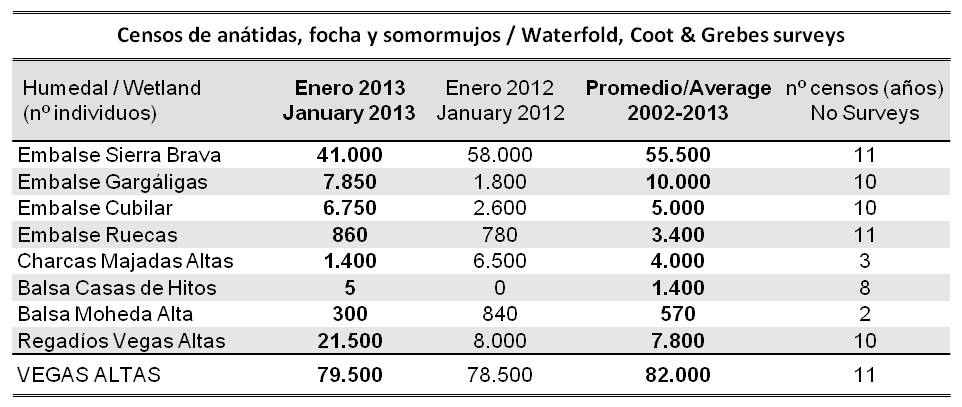
The overall result of the region has yet to be finalised, as we are still waiting for some details, but here are the 2013 results from Sierra Brava reservoir and its surroundings. Also called Zona Centro de Extremadura and Vegas Altas, a term we prefer to call this complex of wetlands, the most important of Extremadura for waterfowl. Specifically eight wetlands have been the targets of the census: four reservoirs located north of the River Guadiana (Sierra Brava, Gargáligas, Cubilar y Ruecas), three ponds for livestock farming (Casas de Hitos, Moheda Alta y Majadas Altas) and a wide area of thousands of acres of irrigated crops, especially rice. During the waterfowl census there were also other small wetlands censused and stretches of the Guadiana river within the region of Vegas Altas, which however are not included in this analysis.

The following table shows counts of waterfowl, coot and grebes obtained in each of the eight wetlands cited. Compared to January 2012, when we used the same methodology and effort, it is seen that the total is very similar (one thousand birds more in 2013), but with a slightly different distribution. Sierra Brava Reservoir remains the most important, although decrease of 17,000 individuals. In contrast, the counts at the reservoirs of Cubilar and Gargáligas increase altogether 10,000 birds and 13,500 more in the ricefields, almost exclusively greylag goose. Majadas Altas ponds had reduced numbers down to a quarter, perhaps because during the previous weeks people have been hunting ducks here. The Casas de Hitos has lost almost all wildfowl after changing its use from agricultural to industrial (associated with a solar thermal plant). The comparison with the average of the 2002-2013 censuses is only indicative and should be treated with caution, since they were made with different teams and methods. Still, the 2013 figures are close to the average of the last 12 years.


The detected species and their abundance are given in another table. The most numerous were the shoveler and the greylag goose, with nearly 19,000. Next in importance the teal and pintail ducks, mallard and gadwall. All other species have less than a thousand individuals, their presence in some cases being anecdotal. Compared to January 2012, we see a sharp increase in the number of greylag geese, probably because of the major flooding of the rice fields. The pintail is maintained at levels, while other similar dabbling ducks decrease, in particular, gadwall,wigeon and coot. In 2013 there have been increasing of crested grebe and common pochard, the latter absent in 2012.


Considering exclusively Sierra Brava reservoir, the figures are lower by 17,000 ducks compared to 2012, affecting all species and most especially wigeon (seventh), Gadwall (fourth) and mallards (half). The only increase is the great crested grebe. However, we must bear in mind that the ducks use these dams as daytime resting sites, feeding at night in irrigated land by the day and returning to the same or different reservoir.


The method used was the same as in 2012. Reservoirs and ponds were surveyed in a coordinated system on January 12, 2012 by nine people divided into four teams. The irrigated areas were covered on 14 and 15 January by several teams with the main objective to census waders and cranes respectively, while obtaining information on other waterfowl, particularly on greylage geese. Except in Sierra Brava, in all places direct counts were made, although an estimate was made at Cubilar for the number of teal as to the difficulty of counting (5,000 birds). In the case of Sierra Brava, as in 2012, the method consisted of a mixture of direct census and photographic census. Certain reservoir areas and rare species were recorded in situ and numerous birds were counted after the photographs taken. Link here for more details of this method. Unfortunately, in 2013 the conditions for photography were much worse, due to wind and waves in the reservoir, which has become much more slow and laborious to carry out photographic counts.


As more than one has asked how to count in the pictures we have shown two cases. Above, marking various species by color (blue pintail, teal yellow, red shoveler). This system is very slow, so we preferred the picture below, which involves splitting the picture in sectors and making partial counts by species in each. In this particular example 1519 individuals have been counted, almost 1200 shovelers and the rest common teals and mallards. Photos by Eva Palacios.


Participants in the census of 2013 in Vegas Altas. Coordinador Javier Prieta.  12 January: Javier Prieta and Eva Palacios (Sierra Brava and Casas de Hitos); Marc Gálvez, José Guerra and César Clemente (Gargáligas, Ruecas and Cubilar); Sergio Mayordomo and Antonio Calvo (Majadas Altas and Sierra Brava); Óscar Llama and Javier Fernández (Moheda Alta and support at Sierra Brava). 14 January: Joaquín Fernández, Miguel Ángel Romo, Luis Lozano, Juan Pablo Prieto, Fernando Yuste, Ángel Sánchez, Domingo Rivera, Manuel Gómez Calzado, Ángel Luis Sánchez, Benigno Cienfuegos, Sergio Mayordomo, Marcelino Cardalliaguet, César Clemente, Javier Prieta and Emilio Jiménez. 15 January: José Antonio Román, Fernando Yuste, Marc Gálvez, José Guerra, Juan Pablo Prieto, Marcelino Cardalliaguet, Emilio Peña, José Luis Ciudad and Manuel Gomez Calzado.